
Teamwork Is Swimming
Improve your team's technique and reduce drag

On a recent holiday in Crete my girlfriend and I befriended a lovely couple who had travelled from Brussels. One of our new friends shared that he is a competitive swimmer and swim coach - my girlfriend and I exchanged a knowing look when he said this because earlier that day we’d been ogling the smoothness, speed and effortlessness of his technique in the pool. Don’t judge me, it was an all-inclusive hotel there’s nothing to do other than spy on the other inmates.
This experience has set me off a little swimming obsession in me, and my doom-scroll algorithm now serves up pleasing little ASMR videos of gliding, effortless-seeming freestyle swimming and technique. Like this one
and this one
The excellent Effortless Swimming channel has also been my guide, and I was struck by the framing that coach Brenton gives to the ‘problem’ of swimming. In a few places he urges his athletes to stop training for swimming like they would for running - ie stop assuming that more effort will lead to more speed, or that effortless, smooth and fast swimming is just a matter of improving cardiovascular endurance or muscular strength.
A serious runner may take issue with this, and also argue for the importance of training good technique and efficient movement, however it is usually the case with running that trying harder and being fitter over a given distance will lead to faster times.
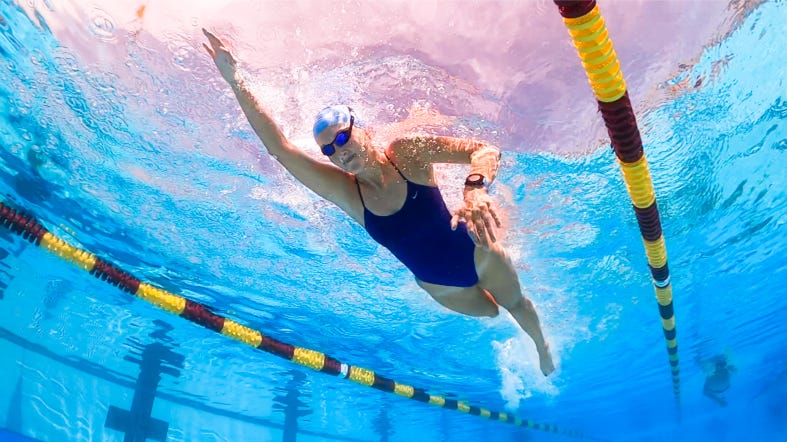
Not so with swimming - water is 800 times denser than air, meaning that swimming well is the art of minimising drag in the water. If a swimmer doesn’t know how to minimise drag, trying harder is likely to lead to slower swimming. This counterintuitive nugget is what’s driving my current curiosity in the sport. To improve at swimming I need to learn how to coordinate my movement better. By trying to swim efficiently and effortlessly - by learning technique - I’ll likely be able to swim faster, further and spending less energy.
This manifests in a few interesting ways. You might think that kicking harder unlocks better swimming. Not so! The basis of good freestyle is a long, streamlined body position, which means that hard, powerful kicks disrupt the body’s shape in the water and increase drag. Legs are also big muscles, so using them too much uses up precious and limited oxygen leading to faster fatigue. Relaxed and purposeful kicks that maintain good body alignment are generally faster over longer distances than hard, thrashy, draggy kicks.
So too with the arms - you might see less trained swimmers windmilling their arms at a high RPM assuming that more strokes propel faster. The ‘front quadrant’ technique encourages freestyle swimmers to always have an arm in front of their head (watch the clip to see what I mean). The fastest part of the stroke involves one arm propelling the body through the water, and the other stretched out straight and relaxed, creating a long streamlined shape for easy gliding.
To paraphrase Carrie Bradshaw - I got to thinking, what could working in a team learn from swim technique? When I work with teams am I helping them be streamlined, or am I being a drag?
I’ll leave you, dear reader to draw analogies yourself, but here are a handful of implications that come to my mind.
What is our drag?
Drag is the both enemy and medium for the swimmer. Unwanted drag slows you down, but using drag to your advantage with your arms is what propels you forward. Teams engaging in complex work won’t find everything easy - but are they maximising the amount of effort that creates propulsion towards the goal? What would it take to reduce overall drag in the system?
In the software teams I work in, the answer to this is often having the right people in the room at the right time to gain shared understanding early. It’s much better to have everyone involved in the work in the room at the beginning to shape and understand the problem together. Then people can break off and work on their separate bits but with a clean and clear understanding of what they are trying to achieve.
It’s possible to succeed with just one or two clever people deciding all the important stuff, but it takes lots of explaining, clarifying, reworking and misunderstanding to get there. It adds drag.
How do we coordinate our movement?
Good swimming technique is largely an issue of coordination and timing. Arms in and out the water at the right time, kicking the correct leg in synchronisation with the driving arm. Rotating the shoulders and head to give you enough time to breath but not so much that it jeopardises the streamlined shape.
When coordination is working, all the effort that each individual limb contributes leads to maximum propulsion. Bad coordination leads to bad connection with the water, limited propulsion and more drag.
So too with our teams, where completing the work is interdependent between a number of skilled practitioners with different perspectives and abilities. As in swimming, it’s often better to slow down to facilitate good coordination. A helpful aphorism in the agile world is ‘fast work, slow people’, meaning that if you want the work to flow quickly and easily, each individual probably shouldn’t be operating at 100% effort all the time.
Just as its helpful to have a relaxed arm in front of my head to allow the other arm to drive me forward, perhaps it’s better for one teammate to take the foot off the gas at the right time so they can support their colleagues as and when they need help.
Keeping balanced
Given the importance of a streamlined body position in swimming, good technique involves keeping the body balanced. A mistimed kick or a weak and wobbly core can upset your balance; increasing drag, reducing force transfer per stroke and using up oxygen. Legs kick gently to keep balance, and the ‘front quadrant’ technique with the arms counterbalances the legs.
Maintaining balance in the water is a delicate dance between rigidity and flexibility. The belly and hips need to be tight, but the arms and feet should be relaxed. There’s an optimum amount of shoulder and hip rotation for each swimmer.
In our teams we have many things which keep us balanced, but need enough flexibility to allow for movement. Our cadence of collaboration (including but not limited to meetings) should be predictable enough that people know where they should be and when. It should be transparent how we make different kinds of decisions. Embodied and imaginal elements of our team culture create a kind of stability which allows for force transfer through the work and propulsion towards the goal.
Training for technique
Good swimmers know how to drill to improve their technique. It was a game changer for me to realise that if I set out to swim 40 lengths, by length 10 I’m starting to tire and my technique deteriorates. I may be able to complete the 40, but by the end of that session I’m probably a worse swimmer than when I started. I get 10 lengths to teach my body good patterns and 30 to teach it terrible patterns. The next time I get in the pool I’m more likely to reproduce the bad technique.
Swimmers have all sorts of funky drills and tools to help them finesse their stroke. One arm drills, slow motion strokes, sculling, using snorkels, fins and hand paddles are all part of the swimmer’s armoury to help them improve. Even when training the full stroke, it makes much more sense to split a 1km swim into 10 sets of 100m with good form than to grind out the whole lot in one go.
I learnt what this looks like in a team context from Salesforce’s Paige Watson at Agile Manchester 2024. High performing teams get together to engage in deliberate practice - the art of a team getting better at coding (or whatever it is they do to add value) together. This involves simplified exercises to practice specific elements of the work in collaboration. In the coding example it might mean working on an easy and well known coding puzzle, but using a new or tricky technique.
The cognitive effort is therefore focussed on the thing we want to get good at, rather than trying to solve a multi-facetted and gnarly problem and hoping to somehow sharpen our tools in the process. What would this look like in your workplace?
Teamwork is technique. We should help our teams improve it.
I hope you enjoyed this edition of Intelligent Teams - an exploration of practical wisdom and the sciences of mind. If you did and want to receive every edition of Intelligent Teams (including podcasts and posts like this) please do subscribe, and leave me a like or a comment, it really means a great deal to hear from my readers and listeners.
I’m also running an in-person workshop in London on 25th July with my friend Ollie Yates, bringing techniques from the art of clowning to create an immersive and reflective play experience to help you find new perspectives and solve problems better.
I’d love to see you there, you can book tickets and find out more here
Great analogy and insights!