
Emergent Play
Learning from the art of clowning

Today I sat in a conference centre room and tried to non-verbally encourage 3 strangers to act out making coffee from ground acorns, and I believe it made us all better leaders.
The context was a session that I ran with my friend Leaf at Agile In The City Bristol. Leaf and I met at a clowning course last year (which I wrote about at the time). I want to share a few of the ideas that led to us bringing something so silly and so serious to the world of agility.
Why Clown?
I’ll ask you to shed your preconceptions about what a clown is, many of which come from Victorian era caricatures of a circus act. We wore no face paint, we rode no unicycles, and no, we did no juggling.
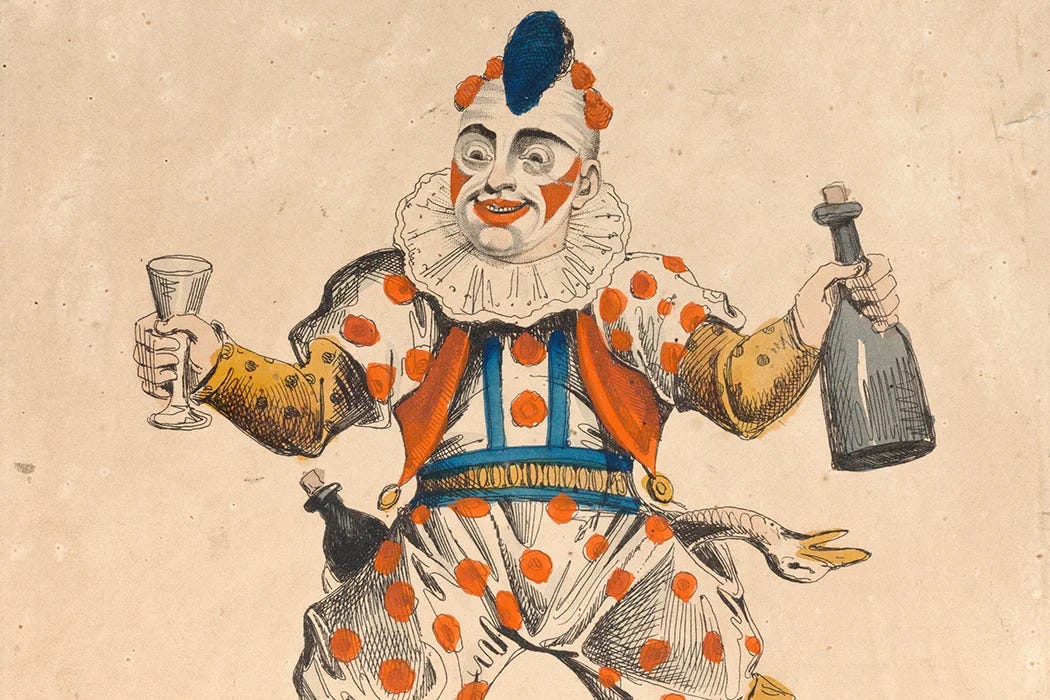
Clowning is a dramatic art form that deals with improvisation, responding to failure and playing the role of a trusted outsider. A clown’s humour and skill lies in their ability to offer up a joke - the ‘flop’ - which is expected to fail. The humour come in when the clown exaggerates and has a real response to the flop. This response connects with the audience and brings them in on the gag. Whereas a comic can get laughs through words and ideas and an actor can portray a particular character, the clown connects through authentic response to failure.
This is deep work. A clown must be able to tap into real emotion in order to exaggerate it for comic effect.
A clown will often also have a unique take on a problem, or show how something we think of as normal is actually absurd. It’s an important role for a group, to have someone who can help us see how silly we are, but do it in a way that feels safe and non-threatening.
Consider the place in our collective imagination of Shakespeare’s court jesters. They were both part of the court, and apart from it. The jester could make fun of the most powerful people in the realm, skilfully weaving into the life of those in power. Enough to satirise and poke fun but never so much as to cause real harm or offence.
That’s probably why we think of the clown as lonely. They are burdened by their perspective. A clown needs to be enough of an insider to see understand the rules that people take upon ourselves to live with others. Yet they must also be an outsider, who can see how these rules and artifices are absurd. They use their privileged position to gently reflect back to the society its own contradictions and unspoken tensions.
If the clown is part of the group, they won’t be able to play this role. So they sit between two worlds, burdened, gifted, and alone.
Emergent play
When it comes to our teams, a clown-like figure can be useful. In the agile world I’d argue that this is played by the Agile Coach, Scrum Master or Delivery Manager. These people are both embedded in teams and separate from them. As a Scrum Master you are there to offer perspective and support, but you aren’t living and breathing the same reality as the team day to day. You are always present, but cannot be integrated in the same way as the other contributors.
I play these roles in my work, and I find it lonely. I may have co-conspirators in the organisation with the same job title and concerns, but they are rarely entangled with the same day to day concerns as me. The people I spend most of my professional time with - many of whom I adore and admire - I keep at a certain distance to be able to offer the most valuable thing I can; my perspective.
Which makes so important - even urgent - to find ways for us, the modern corporate clowns, to find our spaces for connection, exploration and play.
Enter today’s workshop.
We set up an intentional and safe space for other agilists to play and explore. Humans are set up to value ritual, and we created rituals and sacred objects (Leaf’s clay Omphalos pictured below) to elevate the session. This created a container to allow us to play some incredibly silly games. All of them involved some invitation to do something that would involve taking risks. Small ones at first, and culminating in games of huge ambiguity. The participants had to trust us and each other, and in that fertile space we found space to just play.
At one point everyone was ripping up our written instructions and whooping as we tossed them into the air in triumph, a moment later everyone was sat on their chairs rhythmically tapping their knees earnestly. People acted out acorn coffee grinding, and performed dances to total strangers to their delight and bewilderment.
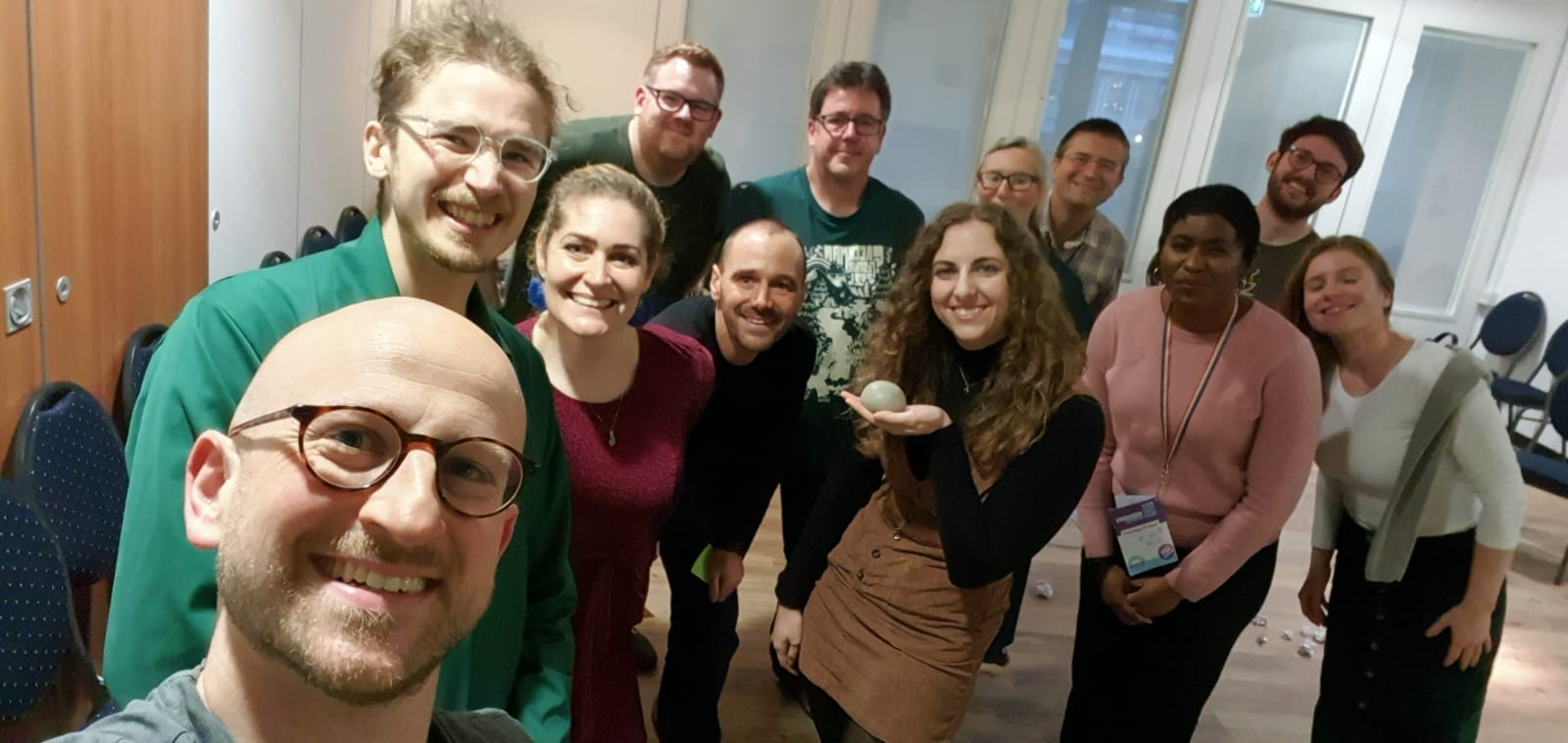
We wanted the space to also foster emergent solutions to problems, so we invited people to start the session by writing down a work or personal problem that they wanted to explore, and placed them up on the wall to be present through the play. We took time to integrate lessons from our weird and whacky clown game experiences into our regular lives, and with a bit of supportive space to discuss and distill lessons from the chaos, almost everyone found that they had made some progress on their problem.
There were some tears and heartfelt gratitude in the closing circle, and when one of our participants said that they didn’t want to leave the space at the end, I knew we had created something special. Between us all we created emergent play, and I can’t wait to do it again.
I’m not just sharing this to tell you how marvellous Leaf and I are, or how you can get in touch to have us run an Emergent Play session in your workplace.
I’m sharing this here because the people who read this Substack work with teams who solve important problems; some of humanity’s most important problems. If we want to help our teams truly rise to their challenges, it is our responsibility to help elevate the spaces we create to reflect that ambition.
If we want our teams to value safety and play, we can create exceptionally safe and playful spaces. If we want to our teams to respect and see each other in their humanity, we can bring containers that make that respect and humanity very salient and present. If we want our teams to be excellent to each other, let’s show them how. Today I feel like I was privileged to snatch a glimpse of what’s possible when we take this stuff seriously, and I bid you to try to do the same.
I’ll leave you on a poem written for me about the session by a Bristol based street artist with a Typewriter called Jonny Heath
We are the omphalos
this squishy hub
where all our stories
criss cross,
function
of living memory
giving birth
to anything
here,
we find the game
right were we
left it
somewhere hidden
giggling between
well-worn formalities
of adulthood,
glittering whispers
of childish wisdom
rediscovered
in this place
we make, with our bodies
and that stuff
that crackles between them